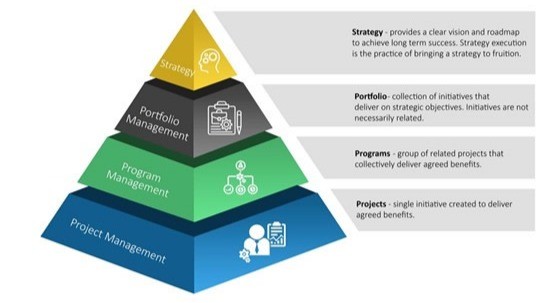
I have often been asked to explain what the differences are between projects, programmes and portfolios. The main differences come down to their scope, purpose and level of management exercised in their delivery.
Key Differences
← Scroll horizontally to see all columns →
| Aspect |
Project |
Programme |
Portfolio |
| What is it? |
A temporary piece of work |
A group of related projects |
Collection of projects/programmes |
| Focus |
Deliver a defined output |
Deliver strategic outcomes/benefits |
Maximise strategic/business value |
| Scope |
Specific to project |
Broader and interconnected |
Across whole organisation/business |
| Success measured by |
Achievement of goals, completion of tasks |
Realisation of intended business benefits and strategic outcomes |
Overall ROI and alignment with corporate strategy |
| Time scale |
Short-term (distinct start and finish) |
Medium to long-term (multi-year, phased delivery) |
Ongoing / Continuous alongside business planning |
| Typical Leader |
Project Manager |
Programme Manager / Program Director |
Portfolio Manager / C-Suite Executive |
It’s much more nuanced than a cursory read across!
Are projects, programmes and portfolios connected?
Project: “Deliver this”
A project has a defined objective and should have a finite life.
For example:
Project: Develop and launch a low-VOC industrial coating by June 2027.
It might involve R&D, regulatory, manufacturing, procurement, marketing and sales, but there is a clear deliverable and endpoint.
Typical questions asked of a project could be:
- What are we delivering?
- When will it be delivered?
- What will it cost?
- What resources do we need?
- Are we meeting the specification?
Project management = doing the work right in the agreed timescale and will typically be governed by a project management system such as Prince II (Projects in Controlled Environments), PMBOK (Project Management Body of Knowledge) or similar framework.
Programme: “Achieve this outcome”
A programme co-ordinates multiple related projects to achieve an outcome that wouldn’t be achieved effectively by managing the projects independently.
For example:
Programme: Sustainable Coatings Transformation
Could contain:
- Project 1 — Water-based formulation platform
- Project 2 — Bio-based raw materials
- Project 3 — Low-carbon manufacturing
- Project 4 — Sustainable packaging
- Project 5 — Regulatory compliance
- Project 6 — Customer trials and adoption
The Programme Manager shouldn’t purely be asking if each project is on time, but should be challenging with:
“Are all these projects collectively delivering the strategic outcome we wanted?”
That means managing dependencies, benefits, resources, risks and organisational change across the projects.
Programme management = doing the right things to achieve the outcome.
Portfolio: “Are we investing in the right things?”
A portfolio sits above programmes and projects.
For example, if a company has £Xm of annual R&D investment, its portfolio might contain:
Growth
- New automotive coatings
- New powder coating platform
- New packaging coatings
Sustainability
- PFAS replacement
- Bio-based resins
- VOC reduction
Defensive
- Regulatory reformulation
- Raw-material substitution
- Product compliance
Operational
- Manufacturing optimisation
- Cost reduction
- Process automation
The Portfolio Manager/Director asks:
“Are we investing our £Xm in the projects and programmes most likely to deliver the company’s strategy?”
They may therefore stop or hold a technically successful project because it no longer represents the best use of resources. A project can be successful while the portfolio decision to fund it was wrong for the business needs or timing.
Portfolio management = choosing the right investments at the right time
The Three Levels of Delivery
- Projects deliver outputs.
- Programmes deliver outcomes and benefits.
- Portfolios optimise investment and strategic value.
Developing or scaling a new coatings technology?
Verdean works with science-led organisations to bridge the gap between technical development and commercial application.